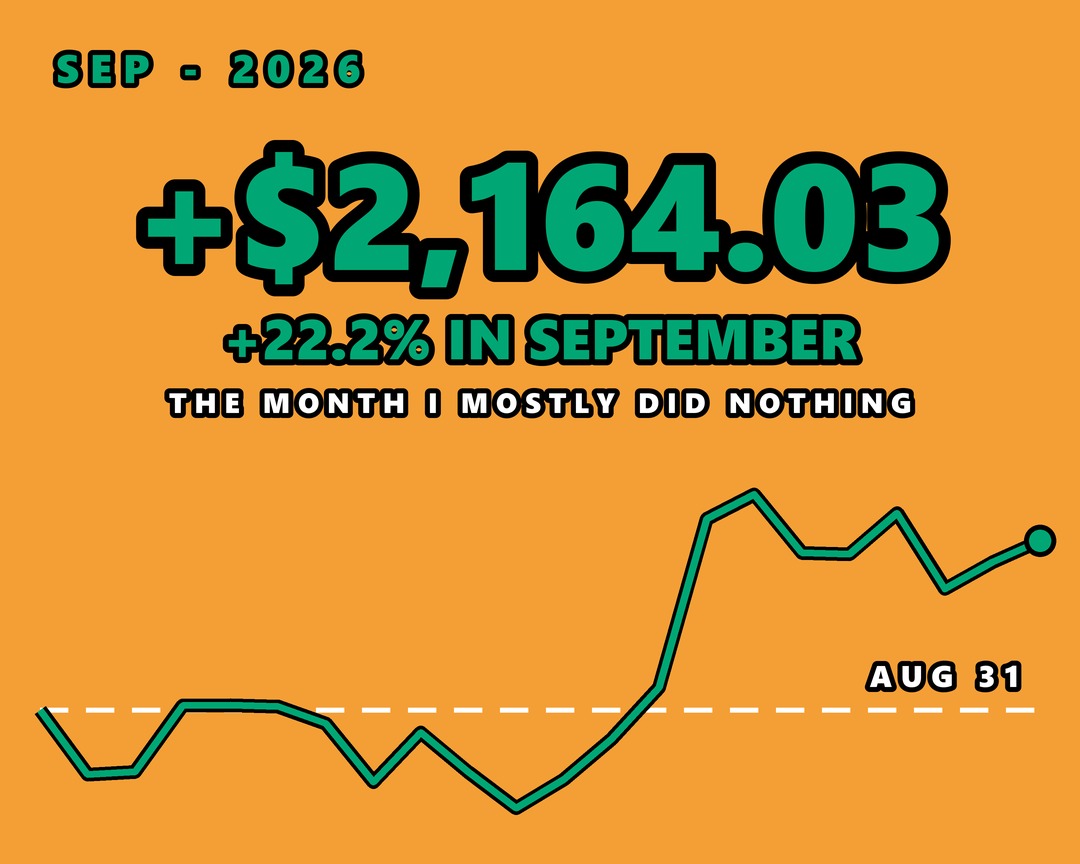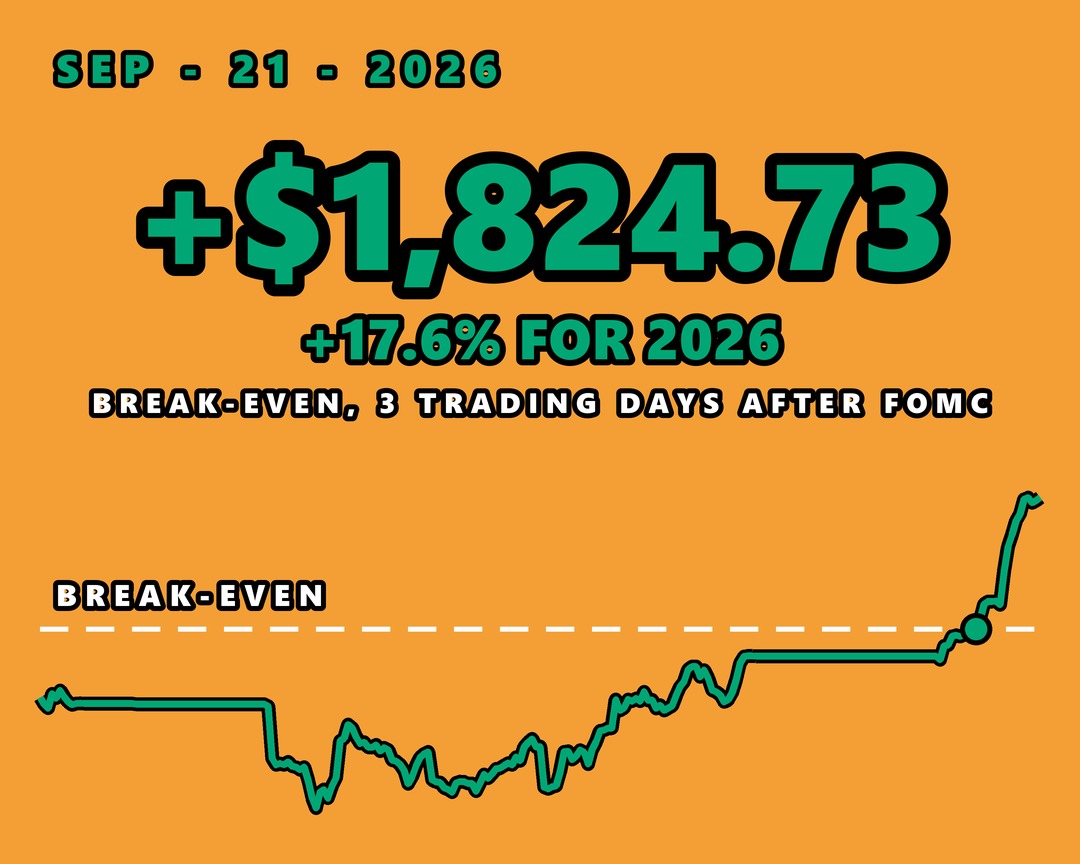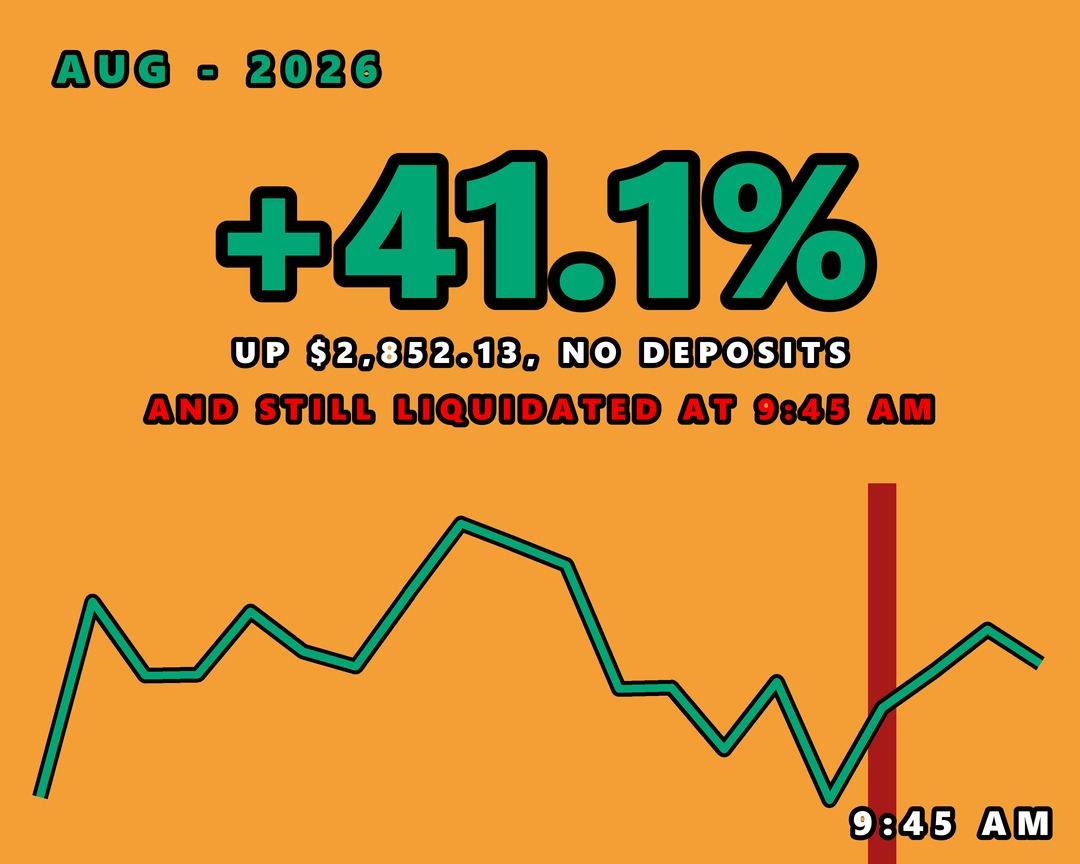
Last week I held one /MNQ contract through a Fed meeting at 95% buying power usage, took three emails from my broker, watched a third of my account disappear in two days, and closed it for +$88.
That's part 1, if you want the damage.
This is the part that came after, and it's the part that actually bothers me.
Trade Summary
Thursday afternoon, out of the position, hands still shaky, I started thinking about other Fed meetings.
And a pattern assembled itself in my head. Fully formed, felt like something I'd always known:
Vol expands into the meeting. Market drifts down. At 2pm it shoots up. Then it goes down as they talk. Then it crashes at night. Then it shoots back up again.
That felt true. It felt like experience. It felt like the thing I'd just lived through and also like every Fed meeting I could remember.
And then I thought: if that pattern is real, I never have to be surprised by it again. I could see it coming. I could even trade it on purpose.
So I went and tested it.
The test
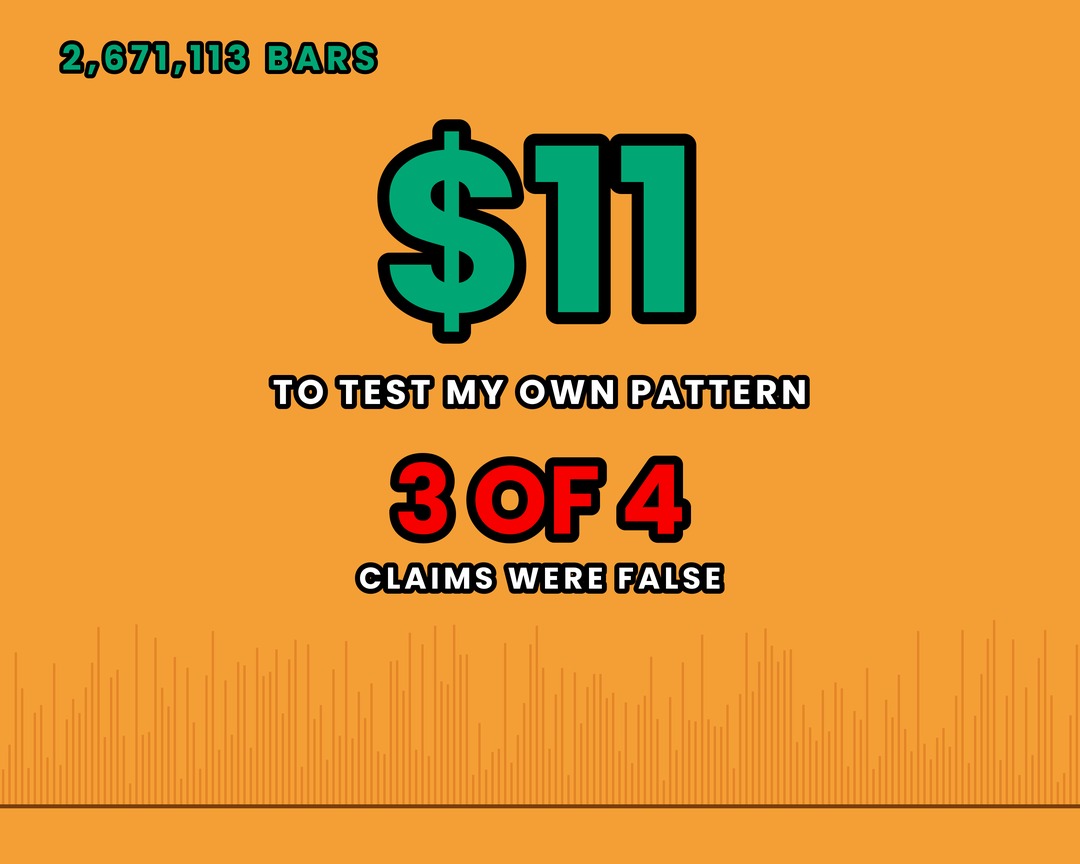
I pulled every one-minute /NQ bar from January 2019 to July 2026 off Databento. 2,671,113 bars, $9.75. Options data on top ran about $0.08. One wrong symbol lookup cost me $1.18 because I guessed the format instead of reading it.
Eleven dollars, give or take.
I chopped the day into nine pieces. Overnight into the day. Morning. The 2pm statement. The digest before the Chair speaks. The press conference. The last hour. The overnight legs.
And here's the part that actually matters, the part I almost skipped: I ran all nine of those legs on 196 ordinary Wednesdays too.
Because without that, you'll "confirm" anything. Overnight sessions dip and recover every single night. If you only look at FOMC nights you will see a pattern, and the pattern will just be what Globex does on a Tuesday.
60 FOMC days. 196 control Wednesdays. Same measurements on both.
What came back
Four claims. One at a time.
Vol expands into the event. True. Fine. Everyone knows this one.
Market drifts down beforehand. False. It drifts up. Median +0.198% on the approach, positive 75% of the time. I had the sign backwards.
It fades during the press conference. False. The market rises during the Q&A more often than not.
And this one got me, because I could point at the exact fade I'd just lived through. 2:00 PM pop, 2:25 PM given back.
The press conference starts at 2:30 PM.
My fade happened before Warsh opened his mouth. It was the statement being digested. Once he actually started talking the thing rallied 370 points off that low. That's the rally that took me back to flat, the one I didn't sell into.
I had built a memory of the Chair talking the market down. He wasn't even on camera yet.
And here's where it gets stupider. Kevin Warsh has chaired two FOMC meetings in his life. He took over from Powell on 22 May 2026. His first was June, this was his second.
So even if the press-conference leg were real, I'd have been trading a Powell pattern against a Warsh press conference. My entire dataset, all 60 meetings from January 2019 through July 2026, is 58 Powell meetings and 2 Warsh.
A backtest can only tell you about the world it was collected in. Mine was collected in a world with a different guy at the microphone.
Overnight crash then rip back. False. Completely. At every threshold I tested, FOMC nights are indistinguishable from ordinary Wednesday nights. Both drop and recover about 27% of the time at a 0.5% threshold. It's not a Fed thing. It's a night thing.
And on Wednesday itself there was no night crash at all. The low was 16:04, four minutes after the close. What I'd been calling the crash was the last hour of the regular session, down 2.178%, the most violent close in 257 days of my data.
Two real moves. I'd remembered them with the boundary in the wrong place, three days after they happened, while I was still rattled.
The one that almost survived
I'll give you the one that nearly made it, because leaving it out would be cheating.
Split the sample at 2023 and going long from the close into the next open on FOMC days returns +0.598% with a 69% win rate. p=0.002. Against control nights over the same window it's +0.468% excess, p=0.029. Median beats the mean, so it's not one lucky night carrying it.
I wanted this one so badly.
So I went looking for a reason. Policy cycle, 60-day trend, realized vol, drawdown from the highs. Every variable measured as of the prior close, so nothing peeks at the future.
All four came back at roughly +0.11%. Which is exactly the full-sample number that already didn't clear significance. Eight different ways of sampling the same nothing.
The calendar separates the result by 0.69 points. The best actual market condition I could find separates it by 0.28 and doesn't clear.
When a split works on a date and nothing you can measure beforehand reproduces it, you haven't found an edge. You've found a coincidence with good manners.
And one more thing. I ran about 30 tests. With 30 tests there's a 77% chance at least one comes back "significant" when absolutely nothing is there.
I ran 30 tests and found one significant result. That's not a finding. That's arithmetic.
The part I'd rather not publish
My control group was broken.
One line, and a step size that quietly computed to 1. So instead of sampling Wednesdays across the whole period, it took the first 200. 176 of my 197 control days came from 2019 to 2022.
I was comparing FOMC days against COVID.
Every comparison in the study was biased and I only caught it because an era split showed a 176/21 control breakdown against a 31/29 event breakdown, and those two numbers looked stupid next to each other.
Fixed it, reran everything. All the volatility ratios went up. The 2pm impulse went from 3.01x to 3.75x.
If I hadn't caught that I'd have published a smaller number and never known.
The thing that IS real
One thing survived clean, and it's not what I expected.
FOMC mornings are half as volatile as ordinary Wednesday mornings. 0.52x. The market goes quiet and waits.
Then 2:00 PM hits and the ten-minute impulse window runs 3.75x normal. The press conference runs 2.94x.
But here's the kicker. The whole session is only 1.41x a normal day. And a week containing an FOMC meeting? 1.095x.
The Fed doesn't add volatility to the day. It moves it. The quiet morning pays for the loud afternoon.
Which means if you're writing premium across an FOMC date you're not facing 200% more risk. You're facing about 10% more over the week, and IV usually rises by more than that.
If you want to price one of those, there's an options profit calculator here. It's free and I earn nothing from it.
So I checked my covered call script for changes. It needs none. It's been handling this correctly the whole time without knowing what the Fed is.
Takeaways
- I built the pattern after the event, and it felt like memory. I wasn't lying to myself on purpose. Thursday afternoon a clean six-step pattern appeared in my head and it felt like something I'd observed for years. It was three days old. Every testable piece of it was wrong, and the one I could point to hardest, the press conference fade, happened before the press conference started. If you've been through something frightening in the market, your account of it is evidence about you, not about the market.
- A control group is the whole experiment. Nine measurements on 60 FOMC days tell you nothing. The same nine on 196 ordinary Wednesdays is what turns them into an answer. Every claim that died, died because a normal Wednesday did the same thing.
- Count your tests before you believe your result. Thirty tests, one significant finding, and a 77% chance of getting exactly that from pure noise. If you don't know how many times you looked, you don't know what your p-value means.
Verdict
Not real. Three of four claims dead, and the survivor runs backwards from what I believed.
So what did $11 actually buy me? Not an edge. It bought me the knowledge that the story I told myself on Thursday afternoon was manufactured, and that I would have traded it. Twice as big, next time, because now I'd have "seen it before."
That's the cheapest tuition I have ever paid, and I have paid some very expensive tuition around here.
The 2023-onward thing is still technically alive. It's a live hypothesis now, not a strategy, and I'll test it forward from the September meeting at about eight events a year.
Ask me in a year. If it's still there I'll say so. If it's gone I'll say that too.
There was one more question sitting right there, and it took me about four minutes to get to it. If I can't tell you which way it goes, can I sell the fact that it moves?
Catch you next week.
Growing Tendies does not accept any liability for any loss or damage which is incurred from any loss of money on a trade. All trades are done using the tastytrade platform.