Disclosure: I earn nothing from this page. There are no affiliate links here, and I have no relationship with either firm. If that ever changes, I will say so right here, in this spot, before anything else.
Rules verified July 2026, from Topstep's and Apex's own help centers. Both firms changed their rules significantly in the first half of 2026. Check the current terms before you pay for anything.
And the disclosure that actually matters: I have never traded a funded account. Not Topstep, not Apex, not any prop firm. I trade futures with my own money on tastytrade. Everything on this page about how these two programs work comes from their own rulebooks and help centers, not from personal experience passing an evaluation. If you want a review from somebody who has run both accounts, this is not that page. What it is, is an accurate one, including the failure rates the firms would rather you skipped.
The short answer
If you are new to futures and you have never passed an evaluation before, start with Topstep, the $50K account, at $49 a month.
If you have already passed an evaluation somewhere, you exit your winners cleanly, and you want to run several accounts cheaply, Apex is built for you.
That is the whole article. Everything below is why.
The comparison, side by side
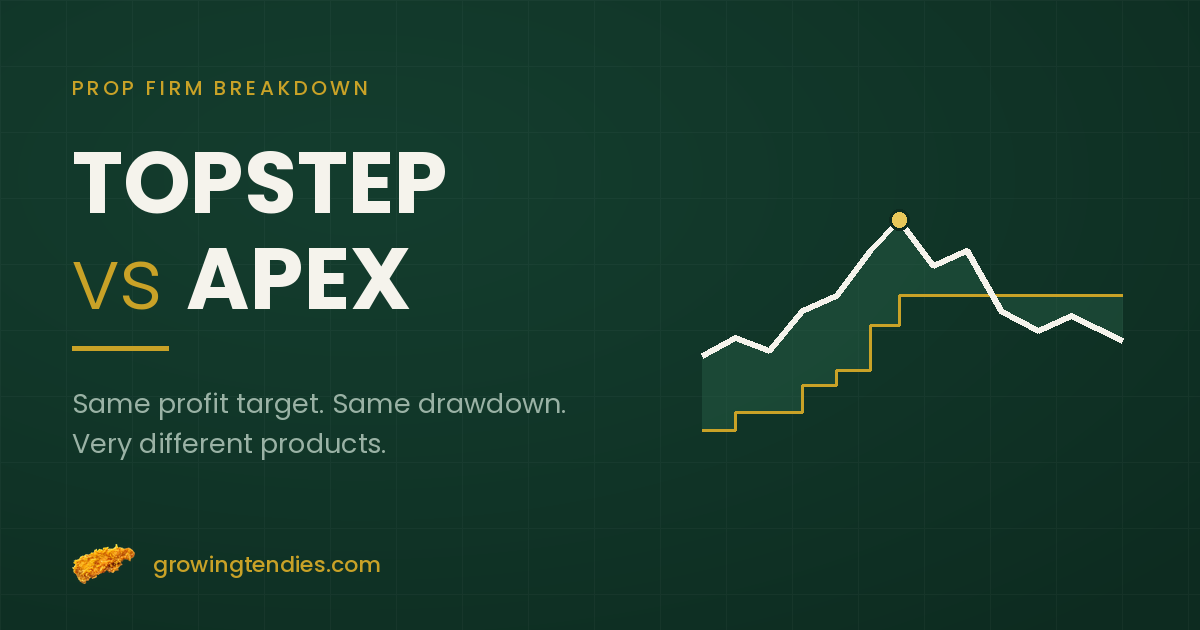
Same profit target. Same drawdown. Very different products.
| Topstep | Apex | |
|---|---|---|
| How you pay | Monthly subscription | One-time fee, since March 2026 |
| Entry price, $50K | $49 per month | Varies, almost always discounted |
| Account sizes | $50K, $100K, $150K | $25K, $50K, $100K, $150K |
| Profit target, $50K | $3,000 | $3,000 |
| Max drawdown, $50K | $2,000 | $2,000 |
| Drawdown type | Trails your end-of-day balance | Your choice: end-of-day or real-time intraday |
| Time limit | None | 30 calendar days |
| Fastest possible pass | 2 days | 1 day |
| Daily loss limit | Yes, $1,000 on the $50K | EOD accounts only, none on intraday |
| Profit split | 90% | 100% |
| Activation fee | $149 | Yes, separate from the evaluation fee |
| Is the funded account real money? | Simulated, until you are called up to a Live Funded Account | Simulated, always |
How Topstep actually works
Three stages, in order. No shortcuts.
Stage one is the Trading Combine. It is a monthly subscription. You pay $49 a month for the $50K and it rebills every 30 days until you pass or you cancel.
There is no time limit. That matters more than it sounds like it does.
You have one rule and two objectives.
The rule: do not let your balance touch the Maximum Loss Limit. On the $50K that is $2,000, and it trails your end-of-day balance upward as you make money.
The objectives: hit $3,000 in profit, and keep your best single day under 50% of that profit target.
That consistency target is why you cannot pass in one day. Topstep says it plainly on their own site. You can pass in as few as two days, but a single monster day will not get you funded.
Stage two is the Express Funded Account. You pay a $149 activation fee. Now you are trading a simulated account that pays out real cash on your profits, and you keep 90%.
To get a payout you pick one of two paths. Standard is five winning days of $150 or more. Consistency is three trading days, as long as your best day stays within 40% of your total profit.
Stage three is the Live Funded Account. This is real exchange capital, not a simulator. Topstep's risk team calls you up. You do not apply.
Hold that thought, because the number attached to stage three is the most honest thing in this entire industry, and I will get to it.
How Apex actually works
Two stages. Faster, cheaper, looser.
Stage one is the evaluation. As of March 2026 Apex switched from a monthly subscription to a one-time fee. You pick your account size, and you pick your drawdown type.
You get 30 calendar days of access. No extensions.
On a $50K intraday evaluation you need $3,000 in profit without ever touching a $2,000 trailing drawdown that follows your peak balance in real time, including unrealized profit.
There is no minimum number of trading days. Hit the target in one session and you have passed.
There is also no daily loss limit on the intraday evaluation. Apex says so directly. Risk control is the trailing threshold and nothing else.
Stage two is the Performance Account. You pay an activation fee, and you keep 100% of approved payouts.
You can hold up to 20 of these at once.
And here is the part that gets buried in most reviews. Apex's own risk disclosure says all activity happens in a simulated environment using virtual funds, with no real capital at risk and no live market execution.
The Performance Account is simulated. Permanently. There is no live capital stage at Apex.
That is not a scandal, and it does not mean the payouts are not real. It means the two firms are selling different things and you should know which one you are buying.
The five differences that actually decide it
1. You are comparing a subscription to a coupon
Topstep charges $49 a month and keeps charging until you pass or cancel. Slow and steady. If you take four months, you paid $196 plus the $149 activation.
Apex charges once. But look at their homepage.
There is a banner offering up to 90% off any size evaluation, with a countdown timer on it.
Go back a week later. Different code, same discount, fresh countdown.
So what is the real price of an Apex evaluation? It is the sale price. The sale is always on.
That is not me accusing anyone of anything. It is a marketing model, and it is common in this corner of the industry. But it means one specific thing for you: never pay full price at Apex. If the code is not applied at checkout, close the tab and come back tomorrow.
2. The drawdown is what kills accounts, and Apex lets you pick your poison
Both firms use a trailing drawdown. It follows your balance up as you profit, and it never comes back down.
Topstep sets the Maximum Loss Limit at the end of each day. Your $2,000 buffer is calculated from your end-of-day high.
Apex lets you choose. End-of-day, same idea. Or intraday, where the threshold follows your peak balance in real time, including unrealized profit.
Read that last part again, because it is brutal.
On an intraday account, if you are up $800 on an open /MNQ position and you give it all back, the threshold already moved up to meet that $800. You did not close the trade. The threshold does not care.
Apex is explicit about this: if the balance touches the threshold, positions are liquidated automatically and the evaluation fails immediately. They even note the liquidation fills at market price, so you may end up slightly below the threshold. It still counts as a breach.
For a beginner, intraday trailing is the fastest way to lose an account you were technically winning in.
3. Time pressure changes how you trade, and not for the better
Topstep's Combine has no expiration date. If you have a bad week, you can sit out and come back.
Apex gives you 30 calendar days. No extensions.
What does a deadline do to a trader who is behind on day 24? It makes them size up. Every time.
That is not a rule violation. That is just what a countdown does to your decision making, and it is worth knowing about yourself before you buy.
4. 100% sounds better than 90%, until you ask what you are being funded with
Apex pays 100% of approved payouts. Topstep pays 90%.
On its face, Apex wins. Take the extra 10%.
But the two funded accounts are not the same object.
Apex's Performance Account is simulated, permanently, by their own disclosure. You are being paid out of a payout program, and the payouts are real cash, but there is no path to trading actual exchange capital.
Topstep runs a simulated Express Funded Account too, and then a Live Funded Account on real capital for traders their risk team calls up.
So which is better? It depends entirely on whether you care about the live stage. If your goal is monthly income from payouts, the 10% is a real cost and Apex's number is genuinely better. If your goal is to eventually trade real institutional capital, Topstep is the only one of the two that offers a door.
5. The quiet rules that close accounts
These do not show up in the sales copy.
- Apex has an inactivity rule. If you do not record at least two $50 net profit days within 30 consecutive calendar days, the account is closed. You can lose a funded account by going on vacation.
- Apex has a 50% consistency rule on funded accounts. No single profitable day can be 50% or more of your total profit since your last approved payout. Hit one huge day and the payout button simply does not appear until the rest of your trading catches up.
- Apex has a Safety Net. Your drawdown limit plus $100. Only profit above that line can be withdrawn, and the minimum payout request is $500.
- Topstep has a consistency target too, at 50% of your profit target during the Combine, and a 40% version on one of the payout paths.
- Topstep's daily loss limit is a feature, not a rule break. Hit $1,000 down on the $50K and the platform stops you for the day. Your account survives. Apex's EOD accounts work the same way. Apex's intraday accounts have no such brake at all.
For a beginner, that brake is worth more than any profit split.
The part nobody puts in the comparison table
Topstep publishes its results. Right there in the footer of their own site, for 2025:
- 16.8% of all Trading Combines were passed
- 51.8% of individual traders passed at least one Combine
- 33.3% of traders who reached the funded level ever received a payout
- 0.71% of Express Funded traders were called up to a Live Funded Account
Sit with that last one.
Seven traders in a thousand reached real capital.
I want to be fair to Topstep here, because they are the ones being transparent enough to give you those numbers. Most firms do not publish anything. The honest read is not that Topstep is bad. The honest read is that this is a hard product to beat, and the only firm telling you so is the one you can check.
Apex does not publish comparable pass or payout statistics that I could verify.
So what is the takeaway? If you are budgeting for this, budget like you will fail the first one. Because you probably will.
So which one?
Start with Topstep if:
- This is your first evaluation, at any firm
- You want a daily loss limit that stops you before you do real damage
- You would rather pay slowly than feel a countdown
- The live capital stage matters to you, even at 0.71%
Start with Apex if:
- You have passed an evaluation before and know your numbers
- You close your winners and do not sit on open profit
- You want to run multiple accounts on cheap coupons
- You want 100% of payouts and do not care that it stays simulated
Do not start with either if:
- You are funding the evaluation with money you need
- You have never traded /MES or /MNQ on a simulator
- You are hoping the evaluation will teach you to trade
That last one is the real trap. An evaluation is a test, not a course. It measures a skill you were supposed to bring with you.
How I would actually start
Pick the $50K. Both firms price it as the entry point and the math is the most forgiving.
Trade micros, not minis. On a $50K Topstep Combine you are allowed 50 micros. You do not have to use them. Two /MES contracts is a completely legitimate way to pass.
Target $300 to $500 profit days. Five of those clears the $3,000 target and keeps your best day well under the 50% consistency line.
Journal every session. The trailing drawdown punishes give-back more than it punishes losses, and you will not notice your give-back pattern until you have written it down for two weeks.
And treat the first evaluation as tuition.
Here is what give-back looks like when it is written down. This is a session from my own account, from before I understood any of this.
From my trading journal · June 12, 2024
CPI landed at 8:30 AM and /MNQ went straight up. I was in and out fast, long 5 contracts at 19412.25, flat at 19440.00.
That was $277.50 in about a minute. 1.7% of my account before most people had finished their coffee.
I should have been done for the day.
Instead greed took over and I bought back in near the top, then had to average down to a cost basis of 19425.25. /MNQ spent the next 45 minutes between 19390 and 19420 while I sat there underwater on all five contracts.
It worked out. The market came back, and I closed the day up 5.08% after touching almost 6%.
So no harm done, right?
Now run that exact same morning through a prop firm account. On paper, since I have never held one.
On an Apex intraday evaluation, the trailing threshold would have ratcheted up to meet that $277.50 the second I hit it. It never comes back down. Then those five contracts went about 35 points against me, call it $350.
Would that have blown the account? No. Not on those numbers.
But I would have spent my first hour handing back buffer I could never earn back, on a trade I had already won and already closed.
That is the part I did not understand until I wrote it down. My own account forgives me and waits. A trailing drawdown just quietly moves the floor up behind me while I am busy being happy about a green day.
Frequently asked questions
Can I pass a prop firm evaluation in one day?
At Apex, yes. There is no minimum trading day requirement on the evaluation. At Topstep, no. The consistency target means the fastest possible pass is two days.
Which has the better profit split, Topstep or Apex?
Apex, at 100% of approved payouts versus Topstep's 90%. The catch is that Apex's funded account is permanently simulated, while Topstep has a live capital stage above its simulated one.
Is Apex Trader Funding real money?
Apex's own risk disclosure states that all activity occurs in a simulated environment with virtual funds and no live market execution. Payouts to traders are real cash. The trading itself is simulated.
What is a trailing drawdown?
It is a loss limit that follows your account's high water mark upward and never moves back down. Make $1,000 and your maximum loss limit rises by $1,000. It is the single most common reason evaluations fail.
How much does it cost to get funded?
At Topstep, at minimum one month at $49 plus a $149 activation fee on the $50K, and more if you need more than one month or a reset. At Apex, a discounted one-time evaluation fee plus a separate activation fee that is not discounted. Budget for more than one attempt at either.
Do I need to be in the US?
Apex states its services are intended for US users only. Topstep serves traders internationally, and prices in several currencies.
Before you go
Both of these firms sell the same thing: a test, and the chance to get paid if you pass it.
The test is hard. Topstep's own numbers say 16.8%.
That is not a reason to skip it. It is a reason to walk in with a plan, a position size that is smaller than you want, and money you can afford to light on fire.
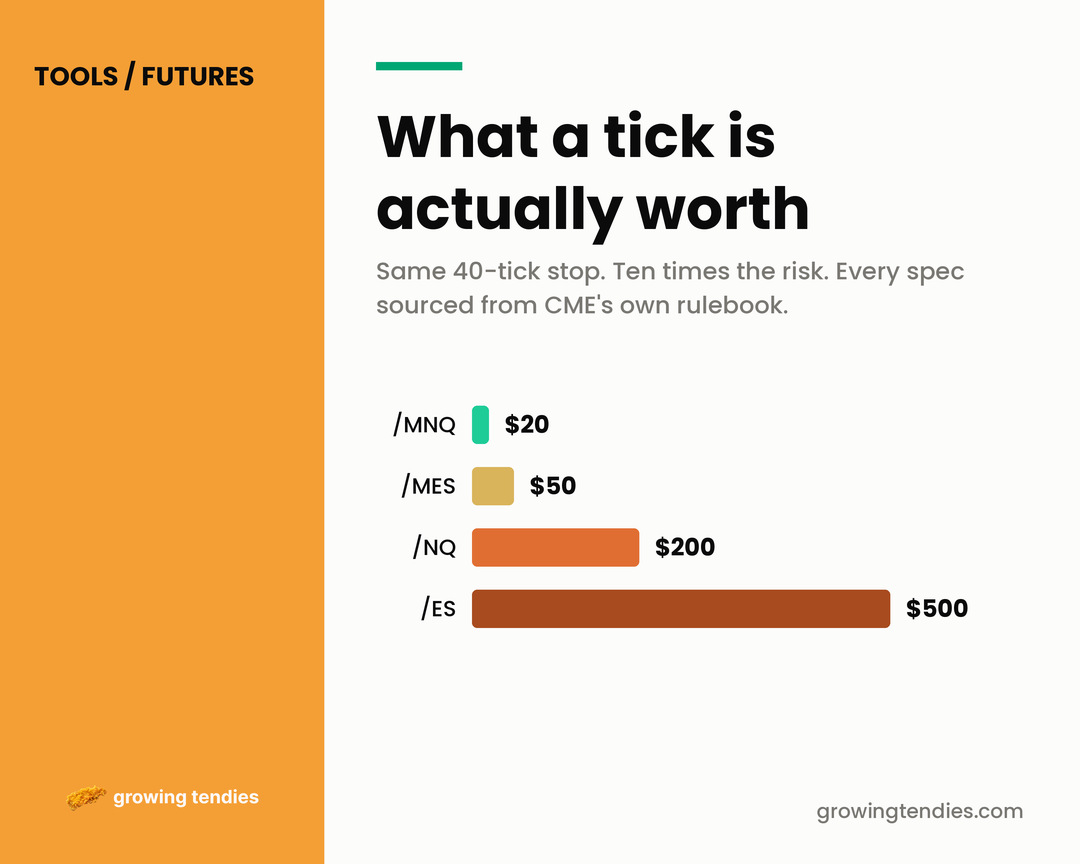
Work the position size out before you sit down, not during. The futures calculator does the tick math for 25 CME contracts, including eight micros.
Whichever one you pick, the difference between passing and resetting is almost never the firm. It is whether you gave back your morning gains.
Catch you in the next one.
The Give-Back Journal, free
I built a journal for exactly this problem. One row per trading day, about 90 seconds after the close.
It tracks the number that actually fails evaluations: the profit you had at your peak, and the profit you handed back before the bell. It also watches your consistency cap and your remaining buffer, so you know where you stand before the platform tells you.
It is a Google Sheet. It is free. There is no email required and nothing to sign up for.
Make your own copy of the Give-Back Journal
Risk disclosure: Futures trading involves substantial risk of loss and is not suitable for everyone. Nothing on this page is investment advice, and I am not your financial advisor. Evaluation and funded account programs described here are simulated trading products. Past performance does not guarantee future results. Rules, pricing, and terms were verified in July 2026 and change frequently. Always confirm current terms directly with the firm before purchasing.