Disclosure: I earn nothing from this page. There are no affiliate links here, no broker or prop firm deals. If that ever changes, I'll say so right here, in this spot, before anything else.
Every contract spec in this article is quoted from the calculator's own data table, which cites a CME Group rulebook chapter per contract. Links are at the bottom.
You put a 50 point stop on /NQ. A tick is $5, so you do 50 times 5 and get $250. The stop is $1,000, because you just multiplied points by the tick value and a tick is a quarter of a point.
Nothing on your screen tells you. The stop is where you put it and the platform accepted the order.
Here's the whole thing in one line, and everything below is why.
Tick value = point value x tick size. There's no contract at CME where that formula breaks.
All three of those inputs can still fool you.
Start with what a tick is
A tick is the smallest amount a contract is allowed to move. Not the smallest it can move in theory, the smallest increment the exchange will accept.
For /ES (E-mini S&P 500) that's 0.25 index points. The contract is worth $50 per index point. So one tick is 0.25 x $50 = $12.50.
Four ticks to a point. One point is $50. Ten points is $500.
Now do /MNQ (Micro E-mini Nasdaq-100). Same 0.25 tick size, but the contract is $2 per point. One tick is $0.50.
Same tick size. Tick value 25 times apart.
The micro trap
Micros are a tenth of the full contract, with one exception. /MES is $5 per point against /ES at $50. /MNQ is $2 against /NQ at $20. /MGC is $10 an ounce against /GC at $100. Micro Silver is a fifth of Silver, not a tenth.
So you practice on micros, which is the right call, and it's where I started. You get comfortable. Your stop is 40 ticks and you've been telling yourself that's $20 on /MNQ, which it is.
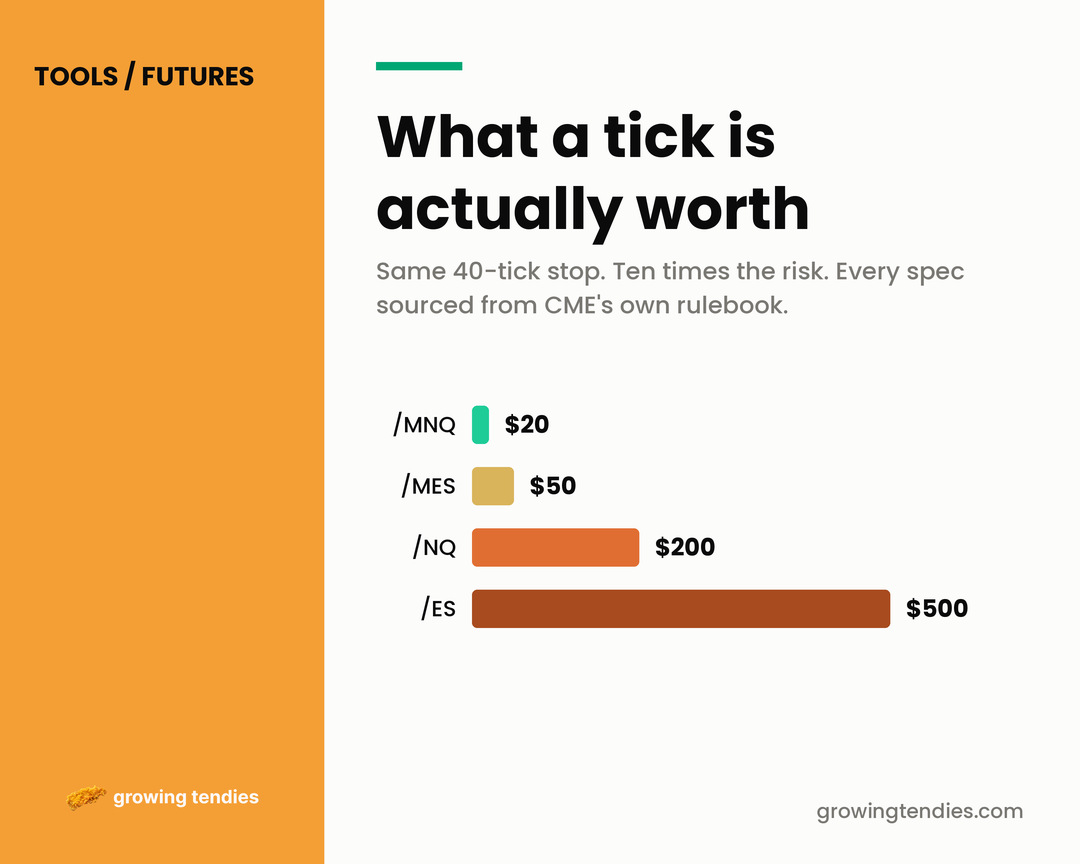
Then you size up to /NQ, keep the same 40-tick stop, and it's now $200.
Ten times the risk, off the same screen and the same stop.
Mine wasn't a micro-to-full switch. It was removing a stop loss and watching /NQ fall 400 points in a day, which cost me $7,000 and the whole year's profit.
Different mistake, same root. I was working off a number that had stopped being true.
So check the tick value, not the tick size, every time you change products.
Treasuries don't use decimals
Treasuries are where the error stops being embarrassing and starts being expensive.
Treasury futures are quoted in points and 32nds. A /ZN (10-Year T-Note) quote of 110'155 doesn't mean 110.155. It means 110 and 15.5 thirty-seconds, which is 110.484375.
Type 110.155 into a spreadsheet expecting a decimal and your entry price is off by about a third of a point. On a contract worth $1,000 per point, that's roughly $330 per contract of pure fiction.
What about that third digit? It's a fraction of one 32nd:
2means a quarter5means a half7means three quarters
So 110'152 is 110 and 15.25 thirty-seconds. 110'157 is 110 and 15.75 thirty-seconds.
And yes, 5 meaning a half instead of five eighths is inconsistent. It's the convention anyway.
The four treasury contracts don't even share a tick size:
Contract | Tick size | Tick value |
|---|---|---|
/ZB (30-Year Bond) | 1/32 | $31.25 |
/ZN (10-Year Note) | 1/2 of 1/32 | $15.625 |
/ZF (5-Year Note) | 1/4 of 1/32 | $7.8125 |
/ZT (2-Year Note) | 1/8 of 1/32 | $7.8125 |
Look at /ZF and /ZT. Same tick value, different tick size, because /ZT is a $200,000 contract and the others are $100,000. Two differences cancelling out into something that looks identical.
Grains use eighths
If you learned the apostrophe from treasuries, you'll read grain quotes wrong, and you'll be confident while you do it.
/ZC (Corn) at 450'2 isn't 450 and 2/32. It's 450 and 2/8 cents per bushel, which is 450.25.
Grains are quoted in cents. The digits after the apostrophe are eighths of a cent. Corn, soybeans and wheat all trade in quarter-cent ticks, and a quarter cent is 2/8, so the only digits you should ever see are 0, 2, 4 and 6. An odd digit means somebody typed something wrong.
Contract is 5,000 bushels. One cent is $50. A quarter-cent tick is $12.50.
I got this wrong when I built the calculator. One parser handled every apostrophe quote as 32nds, so it read 450'2 as 450.0625 instead of 450.25.
Tiny number. Wrong on every single grain calculation.
I only caught it because I wrote the same math a second time in a different language and made the two versions argue with each other. That habit came from spending $11 to find out whether a pattern I liked was real, which is the cheapest money I have spent on this.
The part that costs real money
Tick values are the easy half.
Position sizing is the half that empties accounts, and the arithmetic is one line:
Contracts = dollars you're willing to lose / (stop distance in ticks x tick value)
Say you'll risk $500 on a trade. You're on /MNQ at $0.50 a tick. Your stop is 40 ticks away.
40 x $0.50 = $20 per contract. $500 / $20 = 25 contracts.
Now the same $500 on /NQ at $5.00 a tick. 40 x $5.00 = $200 per contract. You get 2.
Twenty five versus two, off the same risk budget and the same stop.
Two assumptions live inside that formula and both can be false.
It assumes you get filled at your stop, which a gap or a fast market will break.
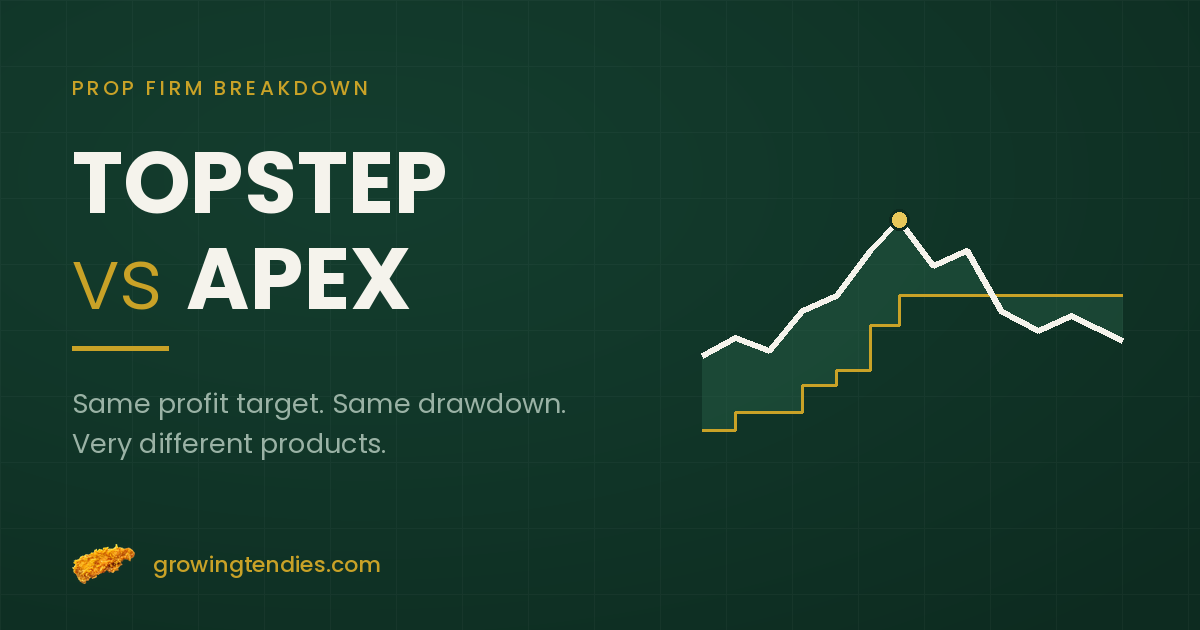
And if you're trading a funded account, it assumes your max loss limit is a fixed number. A trailing drawdown isn't fixed. It moves as your balance moves, so the figure you typed in this morning isn't the one you're working with this afternoon. I went through how the two big firms handle that in Topstep vs Apex.
Use the calculator
I built a futures calculator covering 25 CME contracts, including eight micros. It handles the 32nds and the grain eighths, and it echoes the parsed decimal underneath every price box so you can see what it actually read.
Every point value, tick size and tick value in it is quoted from CME's own rulebook, with the source linked per contract. Not from a broker page, and not from memory.
It's free, nothing's gated, and I don't earn anything if you use it.
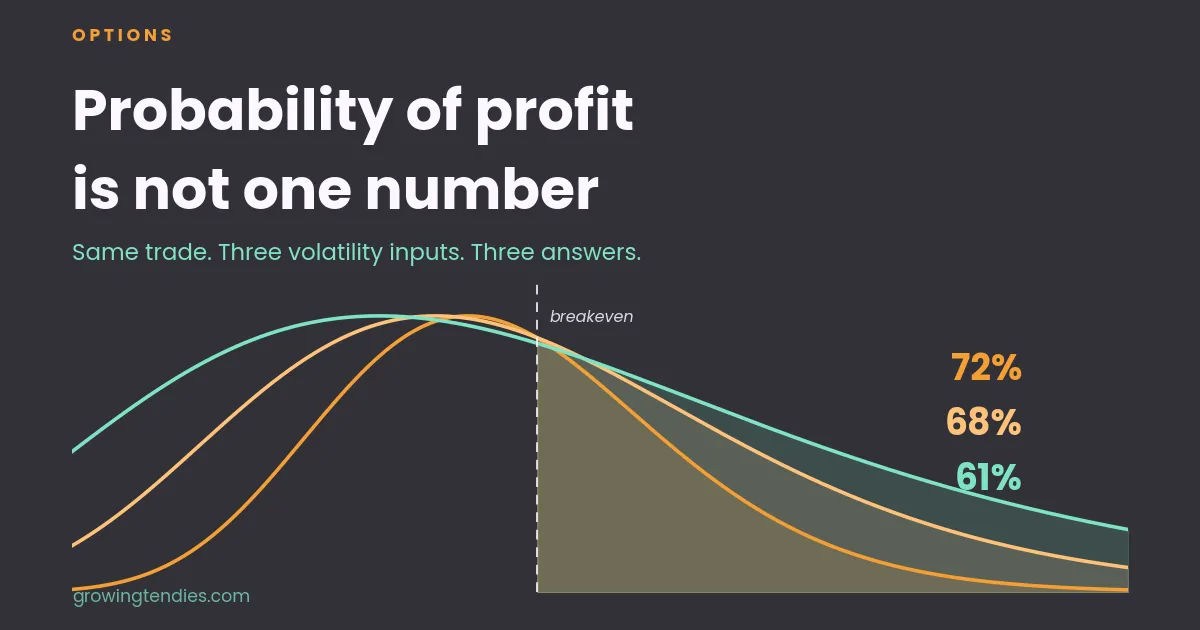
There's an options profit calculator too, if you trade those.
Sources
Specifications are quoted from the calculator's data table, which cites one CME Group rulebook chapter per contract. Those chapters are linked below rather than CME's spec pages, because the rulebook PDFs are stable documents and the spec pages are not.
- /ES: CME Rulebook Ch. 358
- /MES: CME Rulebook Ch. 353
- /NQ: CME Rulebook Ch. 359
- /MNQ: CME Rulebook Ch. 361
- /ZB: CBOT Rulebook Ch. 18
- /ZN: CBOT Rulebook Ch. 19
- /ZF: CBOT Rulebook Ch. 20
- /ZT: CBOT Rulebook Ch. 21
- /ZC: CBOT Rulebook Ch. 10
- /ZS: CBOT Rulebook Ch. 11
- /ZW: CBOT Rulebook Ch. 14
- /GC and /MGC: COMEX Rulebook Ch. 113 and Ch. 120
Tick sizes quoted are outright increments. Calendar and intermonth spread increments differ for several contracts.
This is a journal and a set of tools, not investment advice. Futures are leveraged and can lose more than the amount deposited. Verify contract specs with your broker before you trade.